

The “Invisible Tax” on Your Business: Why Manual Data Entry Costs More Than You Think
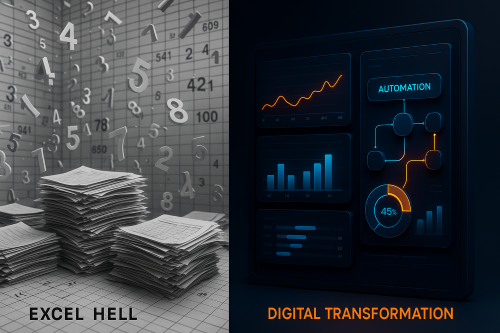
The “Invisible Tax” on Your Business: Why Manual Data Entry Costs More Than You Think Manual data entry is not just a “boring task”, it is a silent tax on your revenue. From the expensive “1-10-100 Rule” of human error to the inability to scale during peak seasons, relying on spreadsheets is holding your business back. This article breaks down exactly where you are losing money and how Digital Transformation (using tools like n8n and Custom Portals) can automate 80% of your admin work in weeks, not months. Published on : December 11, 2025 If you run a business in 2025, you likely have a “hidden employee” on your payroll. Hidden Employee This employee doesn’t generate revenue. They don’t talk to customers. They don’t innovate. All they do is move data from one screen to another. They copy names from emails into Excel sheets. They re-type invoice numbers into accounting software. This isn’t a person, it’s a process. It’s called Manual Data Entry, and it is likely costing your business thousands of dollars every month in lost time and “silent” errors. At Upturne, we help businesses audit their operations. We usually find that the biggest barrier to growth isn’t a lack of customers; it’s a lack of flow. Reasons Why Manual Workflows Are Sabotaging Your Growth 1. The “1-10-100” Rule of Human Error Humans are creative, empathetic, and strategic. We are not designed to be robots. When humans perform repetitive tasks like typing numbers, our error rate is naturally between 1% and 4%. That sounds low, right? But in data management, there is a famous concept called the 1-10-100 Rule: $1: The cost to verify a record when it’s entered correctly. $10: The cost to fix an error once it’s in the system (cleaning the data). $100: The cost if that error is never fixed (e.g., sending a product to the wrong address, missing a student’s exam registration, or under-billing a client). If your staff types 100 records a day, they are making ~4 errors. Over a month, those “small” mistakes compound into massive operational drag 2. The Opportunity Cost: What Aren’t You Doing? Every hour your best employee spends updating a spreadsheet is an hour they aren’t spending on high-value work. You are essentially paying a premium salary for data-entry work. For Schools: If your Admissions Officer is typing student names into a database, they aren’t counseling parents or guiding new students. For Retail: If your Store Manager is manually counting stock on a clipboard, they aren’t training staff or optimizing the shop floor. The Fix: We built an Automated Exam Portal for Wisdom International School, saving them 100+ hours per semester. That time was reinvested into student care, not typing. 3. The “Silo” Problem (Software That Doesn’t Talk) Most small businesses use 5 to 10 different apps: Gmail, WhatsApp, Tally/QuickBooks, Excel, and a CRM. The problem? None of them talk to each other. You become the “human bridge,” copy-pasting data across platforms. The Old Way: Customer emails you → You type it into Excel → You type it into Tally. The New Way: We use n8n Automation to connect these tools via API. When a customer emails you, the system auto-updates the CRM and creates the invoice instantly. Zero clicks. 4. The “Speed” of Business (Customer Experience) Manual processes are slow. In a world of Amazon Prime and instant gratification, speed is a competitive advantage. If a customer asks, “Is this item in stock?”, and you have to say, “Let me check the spreadsheet and call you back,” you have likely lost the sale. Real-time digital systems give you the answer instantly. If your competitor uses automation and you don’t, they will respond to leads faster, ship faster, and close deals faster. 5. The “Scalability Trap” (The Human Bottleneck) This is the most dangerous cost. Manual processes do not scale. If you rely on manual entry, handling 2x the customers requires hiring 2x the staff. Your overhead grows as fast as your revenue, destroying your margins. With Custom Software, scaling is infinite. A digital system can process 1,000 orders as easily as it processes 10. Case Study: NJ Aswins Sweets handles massive spikes in orders during festivals like Diwali. Because their inventory logic is automated, they don’t need to hire an army of temp staff just to track stock. The software handles the volume automatically. Hire a “Digital Worker” Instead You don’t need to fire your staff; you need to promote them. Let them do the human work (sales, strategy, service) and let software do the robot work. At Upturne, we specialize in Operational Automation. We don’t just build websites; we build workflows that run your business while you sleep. Challenge for the Week: Look at your team’s workflow. Identify the one task that everyone hates doing because it’s “boring and repetitive.” That is your profit leak. Want to fix it? (#) with our team. We can usually automate a manual workflow in less than 48 hours. Book a demo edit post Up Turn The “Invisible Tax” on Your Business: Why Manual Data Entry Costs More Than You Think The “Invisible Tax” on Your Business: Why Manual Data Entry Costs More Than You Think Manual data entry is not… edit post Up Turn 5 Signs Your Business Has Outgrown Spreadsheets (And How to Fix It Fast) 5 Signs Your Business Has Outgrown Spreadsheets (And How to Fix It Fast) Businesses outgrow spreadsheets fast. Upturne replaces slow… edit post Up Turn Upturne: A Full Service Development Agency Delivering Fast, Reliable and Secure Digital Solutions Upturne: A Full Service Development Agency Delivering Fast, Reliable and Secure Digital Solutions Businesses today rely on technology to operate…