


UP Turne

Author name: Sophas Samuel

Startup

The 2026 CEO Playbook: 4 Non-Tech Moves to Make Your Business Profitable

The 2026 CEO Playbook: 4 Non-Tech Moves to Make Your Business Profitable The core idea is that businesses in 2026 will win by owning their operations instead of renting generic software. Relying on multiple subscriptions forces teams to adapt to tools that were never built for their workflows. Building custom digital systems turns software into a long-term asset, reduces wasted spend, and directly improves profit margins. Published on : January 5, 2026 If 2024 was the year of “AI Hype,” and 2025 was the year of experimentation, 2026 is the year of Profitability. The era of “growth at all costs” is officially over. Investors, boards, and even your own bank account are no longer impressed by how many users you have or how fast you are hiring. They care about one thing: Margins. As a CEO, your job in 2026 isn’t just to find new customers; it’s to fix the leaks in your bucket. You don’t need to be a coding genius to win this year. You just need to understand how to use technology to do more with less. Here is the plain-English playbook for making your business leaner, faster, and more profitable in 2026. How Smart Businesses Use Custom Software and AI to Multiply Profits 1. Stop “Renting” Your Operations (Build Assets Instead) Imagine if you rented every piece of furniture in your office. It’s cheap to start, but over five years, you pay 10x the value and own nothing. Many businesses do this with software. They pay for 10 different subscriptions—Salesforce for sales, Mailchimp for emails, Trello for tasks—and none of them fit their business perfectly. You are renting generic tools and forcing your team to adapt to them. The 2026 Move: Start building your own “Digital Assets.” Instead of paying monthly fees for 5 disconnected apps, build one simple, custom dashboard that fits your workflow exactly. Why it increases profit: You stop paying for features you don’t use, and you own the code. It becomes an asset on your balance sheet, not a monthly expense. 2. Hire “Digital Interns” (Not Just Tools) In the past, software was like a hammer: it sat there until you picked it up and used it. In 2026, software is becoming like a carpenter: it can do the work for you. This is the shift from “Chatbots” to “AI Agents.” The Old Way: A customer emails support. Your staff reads it, types a reply, and hits send. (Cost: 15 mins of human salary). The 2026 Way: An AI Agent reads the email, checks your inventory policy, processes the refund, and sends a polite confirmation email—all without a human waking up. The ROI: You don’t need to fire your team. You promote them to do high-value strategy while the “Digital Interns” handle the boring, repetitive admin work for free. 3. Kill the “Copy-Paste” Tax Take a walk through your office (or Zoom calls). Look for anyone who has two windows open and is copying data from one to the other. Copying a lead from LinkedIn to a Spreadsheet. Copying an invoice amount from an email to QuickBooks. We call this the “Copy-Paste Tax.” It is the single biggest waste of money in small businesses. It creates errors (typos) and burns out your best employees. The 2026 Move: Connect your systems. If data enters your business in one place (e.g., a website form), it should automatically appear everywhere else (CRM, Slack, Invoice) instantly. The Fix: We use tools like n8n to build these “invisible pipes” for you. It usually takes us less than 48 hours to automate a workflow that saves you 10 hours a week. 4. Niche Down to “Vertical” Solutions The days of trying to be the “Amazon for Everything” are gone. The most profitable businesses in 2026 will be the ones that solve a very specific problem for a very specific group of people. Don’t build: A generic project management tool. Do build: A mobile app specifically for Solar Panel Installers to track roof measurements. Why this matters: When you build specific solutions (Vertical Software), you can charge more because you solve a deeper pain. Your marketing becomes cheaper because you know exactly who to target. Efficiency is the New Growth You don’t need a Silicon Valley budget to execute this. You just need the mindset to look at your business and ask: “Why are we doing this manually?” In 2026, the most successful CEOs won’t be the ones with the most employees. They will be the ones with the most efficient systems. Ready to clean up your operations? At Upturne, we act as your “Efficiency Architects.” We audit your messy workflows and rebuild them into sleek, automated profit engines. (#) with our team to see how we can modernize your business in weeks, not months. Let's Connect edit post Startup The 2026 CEO Playbook: 4 Non-Tech Moves to Make Your Business Profitable The 2026 CEO Playbook: 4 Non-Tech Moves to Make Your Business Profitable Manual data entry is not just a “boring… edit post Startup 5 Profitable Startup Ideas to Build in 2026 (That You Can Launch in 4 Weeks) 5 Profitable Startup Ideas to Build in 2026 (That You Can Launch in 4 Weeks) Manual data entry is not… edit post Automation The “Invisible Tax” on Your Business: Why Manual Data Entry Costs More Than You Think The “Invisible Tax” on Your Business: Why Manual Data Entry Costs More Than You Think Manual data entry is not…

Startup, Transformation

5 Profitable Startup Ideas to Build in 2026 (That You Can Launch in 4 Weeks)

5 Profitable Startup Ideas to Build in 2026 (That You Can Launch in 4 Weeks) The core theme is building software that solves urgent, real-world problems instead of chasing crowded markets. The focus is on replacing manual, inefficient workflows with automation, real-time systems, and AI-driven operations that save time, reduce errors, and lower costs. By targeting users with clear pain points and compliance or operational pressure, this approach creates products that businesses need to run daily, not tools they can afford to ignore. Published on : January 2, 2026 The era of “Uber for X” is over. In 2026, the biggest opportunities aren’t in building massive, generic platforms for everyone. The money has moved to “Micro-SaaS” and “Vertical AI.” Investors and customers are no longer impressed by broad promises. They want specific tools that solve specific, painful problems for niche industries. They want “Boring Businesses” powered by “Exciting Tech.” At Upturne, we analyze market trends to help founders build what sells. Based on the technology we are currently building for clients, here are the 5 most profitable app concepts to launch in 2026. 5 High-Conviction SaaS Ideas Built for Real-World Businesses, Not Hype 1. The “Blue-Collar” Operating System The Concept: Stop trying to sell software to Silicon Valley. Sell it to plumbers, electricians, and pool cleaners. These industries are still running on pen, paper, and phone calls. The Idea: Build a mobile-first CRM specifically for one niche (e.g., “The All-in-One App for Solar Panel Installers”). Key Features: Automated appointment scheduling, on-site invoicing, and GPS crew tracking. Why It Wins: It digitizes an offline industry. We built similar logic for Wisdom International School, replacing physical forms with digital workflows. The demand for “Digital Operations” in traditional industries is massive. 2. The “Hyper-Local” Inventory Marketplace The Concept: Amazon takes 2 days. Local buyers want it in 2 hours. But local shops don’t have real-time inventory online The Idea: A city-specific marketplace where users can search “10mm socket wrench” or “gluten-free birthday cake” and see exactly which local store has it in stock right now. Key Features: Real-time inventory sync (API) and “Click & Collect” booking. Why It Wins: This uses the exact “Real-Time Sync” technology we built for NJ Aswins Sweets. We know how to connect a physical warehouse to a digital frontend instantly. 3. The “Niche” Directory & Verification Platform The Concept: LinkedIn is too noisy. Indeed is too broad. Industries need trusted, verified directories for specialized talent. The Idea: A platform exclusively for hiring Specialized Medical Technicians or Certified Drone Pilots. Key Features: Advanced search filters, license verification uploads, and direct booking. Why It Wins: High-intent traffic. We built CNC Nexus (a machinery directory) and know exactly how to structure complex databases to rank high on Google and handle thousands of listings. 4. The AI “Content Repurposing” Engine The Concept: Every CEO wants to be a “Thought Leader” on LinkedIn, but no one has time to write. The Idea: A SaaS tool where a user records a 2-minute voice note, and the AI automatically converts it into a Blog Post, a LinkedIn Thread, and a Newsletter. Key Features: Voice-to-Text (Whisper API), Generative Writing (GPT-4), and Auto-Posting. Why It Wins: It solves the “Time vs. Content” paradox. Leveraging our experience with Whisper Space (AI Audio apps), we can build this MVP in under 3 weeks. 5. The “Compliance” Micro-SaaS The Concept: Regulations are getting tighter (GDPR, Carbon Tracking, Safety Certifications). Small businesses are terrified of fines. The Idea: A simple dashboard that helps small bakeries/cafes track their “Food Safety Compliance” or “Carbon Footprint” automatically. Key Features: Digital checklists, automated PDF report generation, and expiry alerts. Why It Wins: It’s a “Painkiller,” not a “Vitamin.” Businesses have to buy it to stay legal. This uses the Automated PDF Generation logic we perfected for school hall tickets. Don’t Just Dream It. Build It. The difference between a “Good Idea” and a “Million Dollar Business” is Execution Speed. Most founders spend 6 months trying to find a technical co-founder or managing freelancers who deliver broken code. By the time they launch, the market has moved on. At Upturne, we are your Technical Co-Founder. We don’t just write code; we launch businesses. Using our proprietary AutoStruct AI engine and pre-built component libraries, we can turn any of the ideas above into a Market-Ready MVP in just 4 Weeks. Week 1: Architecture & Design. Week 2: Core Development (React/Node.js). Week 3: AI & Database Integration. Week 4: Testing & Launch. Have an idea for 2026? (#) with our engineering team today. Let’s verify your concept and get you to market before your competitors do. Let's Connect edit post Startup The 2026 CEO Playbook: 4 Non-Tech Moves to Make Your Business Profitable The 2026 CEO Playbook: 4 Non-Tech Moves to Make Your Business Profitable The core idea is that businesses in 2026… edit post Startup 5 Profitable Startup Ideas to Build in 2026 (That You Can Launch in 4 Weeks) 5 Profitable Startup Ideas to Build in 2026 (That You Can Launch in 4 Weeks) The core theme is building… edit post Automation The “Invisible Tax” on Your Business: Why Manual Data Entry Costs More Than You Think The “Invisible Tax” on Your Business: Why Manual Data Entry Costs More Than You Think Manual data entry is not…
Automation

The “Invisible Tax” on Your Business: Why Manual Data Entry Costs More Than You Think

The “Invisible Tax” on Your Business: Why Manual Data Entry Costs More Than You Think Manual data entry is not just a “boring task”, it is a silent tax on your revenue. From the expensive “1-10-100 Rule” of human error to the inability to scale during peak seasons, relying on spreadsheets is holding your business back. This article breaks down exactly where you are losing money and how Digital Transformation (using tools like n8n and Custom Portals) can automate 80% of your admin work in weeks, not months. Published on : December 11, 2025 If you run a business in 2025, you likely have a “hidden employee” on your payroll. Hidden Employee This employee doesn’t generate revenue. They don’t talk to customers. They don’t innovate. All they do is move data from one screen to another. They copy names from emails into Excel sheets. They re-type invoice numbers into accounting software. This isn’t a person, it’s a process. It’s called Manual Data Entry, and it is likely costing your business thousands of dollars every month in lost time and “silent” errors. At Upturne, we help businesses audit their operations. We usually find that the biggest barrier to growth isn’t a lack of customers; it’s a lack of flow. Reasons Why Manual Workflows Are Sabotaging Your Growth 1. The “1-10-100” Rule of Human Error Humans are creative, empathetic, and strategic. We are not designed to be robots. When humans perform repetitive tasks like typing numbers, our error rate is naturally between 1% and 4%. That sounds low, right? But in data management, there is a famous concept called the 1-10-100 Rule: $1: The cost to verify a record when it’s entered correctly. $10: The cost to fix an error once it’s in the system (cleaning the data). $100: The cost if that error is never fixed (e.g., sending a product to the wrong address, missing a student’s exam registration, or under-billing a client). If your staff types 100 records a day, they are making ~4 errors. Over a month, those “small” mistakes compound into massive operational drag 2. The Opportunity Cost: What Aren’t You Doing? Every hour your best employee spends updating a spreadsheet is an hour they aren’t spending on high-value work. You are essentially paying a premium salary for data-entry work. For Schools: If your Admissions Officer is typing student names into a database, they aren’t counseling parents or guiding new students. For Retail: If your Store Manager is manually counting stock on a clipboard, they aren’t training staff or optimizing the shop floor. The Fix: We built an Automated Exam Portal for Wisdom International School, saving them 100+ hours per semester. That time was reinvested into student care, not typing. 3. The “Silo” Problem (Software That Doesn’t Talk) Most small businesses use 5 to 10 different apps: Gmail, WhatsApp, Tally/QuickBooks, Excel, and a CRM. The problem? None of them talk to each other. You become the “human bridge,” copy-pasting data across platforms. The Old Way: Customer emails you → You type it into Excel → You type it into Tally. The New Way: We use n8n Automation to connect these tools via API. When a customer emails you, the system auto-updates the CRM and creates the invoice instantly. Zero clicks. 4. The “Speed” of Business (Customer Experience) Manual processes are slow. In a world of Amazon Prime and instant gratification, speed is a competitive advantage. If a customer asks, “Is this item in stock?”, and you have to say, “Let me check the spreadsheet and call you back,” you have likely lost the sale. Real-time digital systems give you the answer instantly. If your competitor uses automation and you don’t, they will respond to leads faster, ship faster, and close deals faster. 5. The “Scalability Trap” (The Human Bottleneck) This is the most dangerous cost. Manual processes do not scale. If you rely on manual entry, handling 2x the customers requires hiring 2x the staff. Your overhead grows as fast as your revenue, destroying your margins. With Custom Software, scaling is infinite. A digital system can process 1,000 orders as easily as it processes 10. Case Study: NJ Aswins Sweets handles massive spikes in orders during festivals like Diwali. Because their inventory logic is automated, they don’t need to hire an army of temp staff just to track stock. The software handles the volume automatically. Hire a “Digital Worker” Instead You don’t need to fire your staff; you need to promote them. Let them do the human work (sales, strategy, service) and let software do the robot work. At Upturne, we specialize in Operational Automation. We don’t just build websites; we build workflows that run your business while you sleep. Challenge for the Week: Look at your team’s workflow. Identify the one task that everyone hates doing because it’s “boring and repetitive.” That is your profit leak. Want to fix it? (#) with our team. We can usually automate a manual workflow in less than 48 hours. Book a demo edit post Up Turn The “Invisible Tax” on Your Business: Why Manual Data Entry Costs More Than You Think The “Invisible Tax” on Your Business: Why Manual Data Entry Costs More Than You Think Manual data entry is not… edit post Up Turn 5 Signs Your Business Has Outgrown Spreadsheets (And How to Fix It Fast) 5 Signs Your Business Has Outgrown Spreadsheets (And How to Fix It Fast) Businesses outgrow spreadsheets fast. Upturne replaces slow… edit post Up Turn Upturne: A Full Service Development Agency Delivering Fast, Reliable and Secure Digital Solutions Upturne: A Full Service Development Agency Delivering Fast, Reliable and Secure Digital Solutions Businesses today rely on technology to operate…

Automation, Transformation

5 Signs Your Business Has Outgrown Spreadsheets (And How to Fix It Fast)

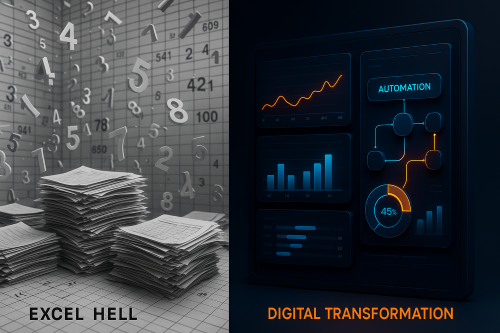
5 Signs Your Business Has Outgrown Spreadsheets (And How to Fix It Fast) Businesses outgrow spreadsheets fast. Upturne replaces slow manual work, mismatched inventory, mobile limits, and fragile formulas with fast custom systems built in weeks, saving time and boosting accuracy. Published on : December 11, 2025 We love spreadsheets. For a new business, Excel is a miracle tool. It’s flexible, free, and easy to start. Excel Hell But as your business grows whether you are managing a school with 3,000 students or a retail chain with hundreds of daily orders spreadsheets start to become a trap. We call this “Excel Hell.” It starts small: one file becomes two. Then you have Inventory_Final_v3.xlsx. Then your staff starts spending half their day copying data from an email into a cell. Suddenly, your “free” tool is costing you thousands in lost productivity and manual errors. At Upturne, we help businesses graduate from spreadsheets to custom digital engines. Here are the 5 signs it’s time for you to upgrade. Signs your business has outgrown spreadsheets and needs real automation 1. You Are Drowning in “Double Data Entry” If your process requires a human to look at one screen (like an email or a paper form) and type that data into another screen (Excel), you are wasting money. The Real-World Cost: We recently worked with Wisdom International School, where staff spent weeks manually typing student details for exam registrations. It was slow, boring, and prone to typing errors. The Fix: We built a custom Exam Registration Portal. Students entered their own data, and the system did the rest. The Result: The school saved 100+ administrative hours per semester. Zero manual typing. Zero errors. 2. Your “Inventory” Doesn’t Match Your “Reality” For retail businesses, a spreadsheet that is updated once a day is dangerous. If you sell an item in-store at 10 AM, but your website spreadsheet isn’t updated until 6 PM, you risk selling products you don’t have. The Real-World Cost: High-volume retailers like NJ Aswins Sweets cannot afford this lag. The Fix: We migrated them to a Real-Time Inventory Engine (using the MERN stack). The Result: The moment a sweet is sold, the inventory count updates everywhere instantly. No more “Sorry, we’re out of stock” calls to angry customers. 3. You Can’t Run Your Business from Your Phone Spreadsheets are terrible on mobile. If you are a founder or operations manager, you need to see your numbers while you are traveling, visiting a client, or at home. If you have to call your office and ask someone to “check the sheet,” your business is tethered to a desk. The Solution: We build Cloud-Native Dashboards. By moving your data to secure cloud servers (like AWS), we give you a mobile-friendly “Command Center.” You can approve invoices, check sales, and monitor staff from anywhere in the world. 4. You Are Scared of “Breaking the Formula” Is there one person in your office who knows how the complex formulas work? What happens if they leave? Or worse, what happens if someone accidentally deletes a cell? Legacy software is fragile. Modern software is robust. When we build Custom Software, we create strict rules that prevent users from breaking the system. Your data is backed up automatically, every second. 5. You Think Custom Software Takes 6 Months This is the biggest myth holding business owners back. They think “Digital Transformation” means hiring a massive consultancy for a year-long project. The Upturne Difference: We believe in Velocity. We don’t build from scratch; we use our proprietary AutoStruct AI engine and pre-built component libraries to launch functional software in weeks, not months. 48 Hours: For landing pages and simple portals. 4 Weeks: For complex operational dashboards and MVPs. Conclusion: It’s Time to Automate You don’t need to be a Fortune 500 company to have custom software. You just need a partner who understands your operations. If you are spending more time managing your spreadsheets than growing your business, it’s time to talk. Ready to reclaim your time? (#) with Team Upturne. We’ll show you exactly which manual tasks we can automate in your first week. Automate your workflow edit post Up Turn 5 Signs Your Business Has Outgrown Spreadsheets (And How to Fix It Fast) 5 Signs Your Business Has Outgrown Spreadsheets (And How to Fix It Fast) Businesses outgrow spreadsheets fast. Upturne replaces slow… edit post Up Turn Upturne: A Full Service Development Agency Delivering Fast, Reliable and Secure Digital Solutions Upturne: A Full Service Development Agency Delivering Fast, Reliable and Secure Digital Solutions Businesses today rely on technology to operate…

Scroll to Top